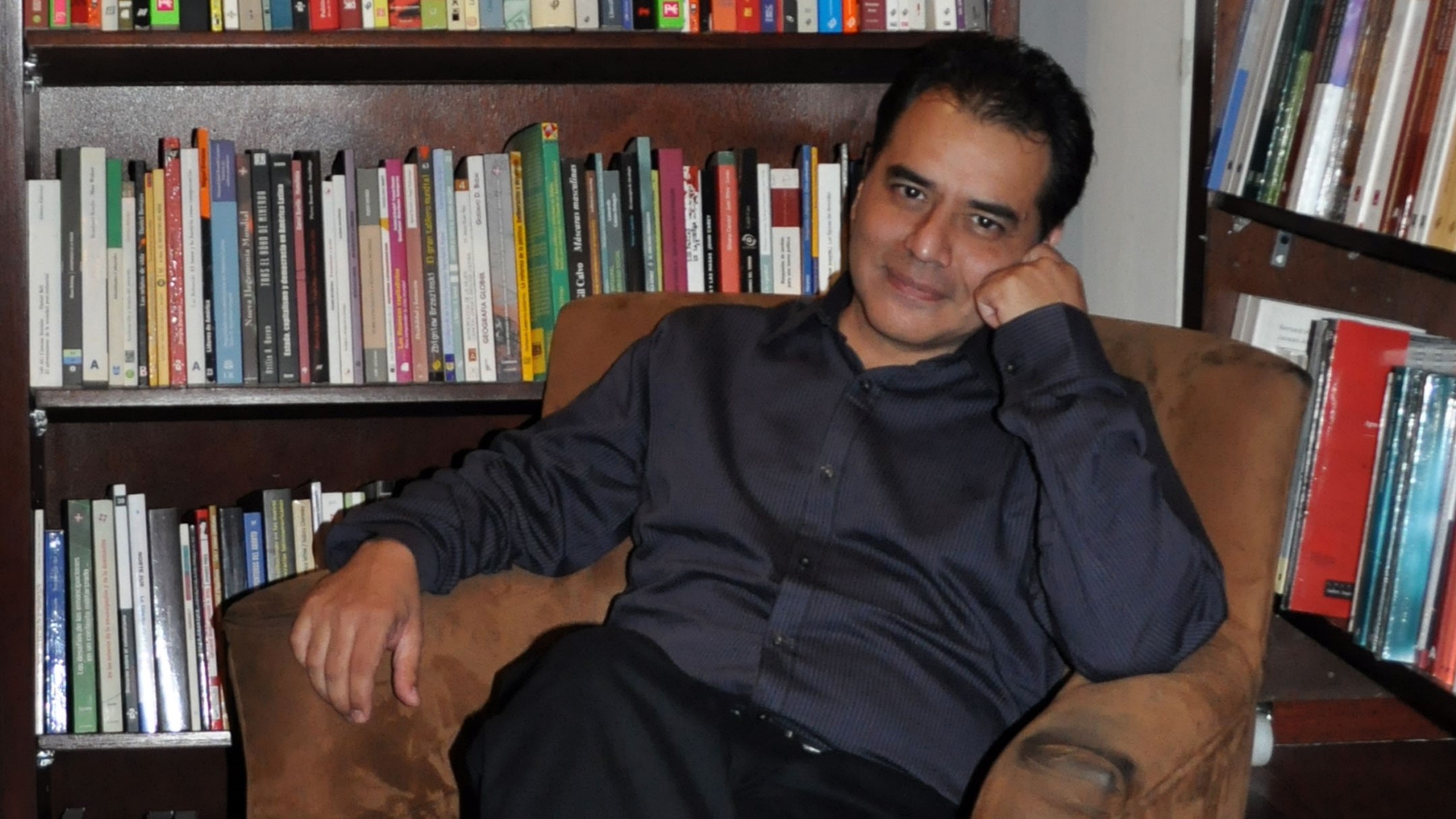
BIOGRAPHICAL SUMMARY
Jorge Ávalos (b. 1964) is a Salvadoran poet, storyteller and playwright. A true polymaph, he is also a very active art critic and historian, a documentary photographer and a producer of his own plays and short films. He is the editor of the online magazine La Zebra since he founded it in 2016. He believes that the wide range of his interests and his tireless activity may be due to the fact that he is neurodivergent.
His work in all genres is surprisingly entertaining, and he uses this gift in his plays and theater productions —which have proved successful with audiences and have reached tens of thousands of people— to address pressing political and social issues: his plays have dealt with the massacres of civilians carried out during the war by the government, with judicial impunity, government corruption, forced migration, human trafficking, sexual abuse, homophobia and transphobia. As a progressive voice in literature and the arts he was the first newspaper editor and magazine publisher to give ample space in newspapers and in his own magazine to gay and lesbian writers (in El Salvador discrimination and hate crimes are on the rise), and he has rescued forgotten feminist and gay writers from the past, writing their biographies and collecting their work. Due to the rise in hate crimes against transexual people (including murder), his last play, The Wonders Hotel, dealt with gender-based violence, including homophobia and transphobia.
Awarded five national literature prizes in various genres, he also became the first writer in the region to win the two Central American literature prizes: the “Rogelio Sinán” of Panama, for La ciudad del deseo (City of Desire, 2004); and the “Mario Monteforte Toledo” of Guatemala, for El secreto del ángel (The Angel’s Secret, 2012). His short stories, which are richly imaginative and mix realism and fantastic elements to highlight social issues, are collected in his book La selva y el mar (The Jungle and the Sea, 2024). He is also a prolific writer of flash fiction, often anthologized (in El Salvador, Mexico, Nicaragua, Colombia, Brazil and Spain), and collected in Clara y Luna (Clara and Luna, 2024).
In 2024 he launched the publication project of his complete poetry, made up of about twenty sets of poems which will be collected in several volumes. The first one of these, El espejo hechizado, was published in November 2024. Némesis, his collected early poetry, mostly written during his exile during the civil war in El Salvador, will be published in 2026.
In theater he received in 2009 the Ovación Theater Award for his police drama La balada de Jimmy Rosa (The Ballad of Jimmy Rosa), which he produced that same year; and in 2015 he premiered La canción de nuestros días (The Song of Our Days), which won the 2014 Ovación Award; in 2023 he wrote and directed El hotel de las maravillas (The Wonders Hotel). Another of his plays, Ángel de la guarda (Guardian Angel), was in repertory 8 years from 2006 and opened the International Theater Festival of Teatro Cervantes in Buenos Aires in 2014; it toured Argentina and Central America. All his plays have been critical and public successes.
As a screenwriter and director of short films, he has received recognition for Malicia (Mischief), with which he won a film production award from the Culture and the Arts Fund of San Salvador, 2018 (FOMCASS); and for Duro de amar (Tough Love, 2019), which premiered at the San Giò Festival, Verona, Italy, where it won the Best Actor Award, and which was the official selection of El Salvador at the Festival Ícaro, Guatemala, 2019, in the Experimental Cinema category.
He has also received recognition for his investigative journalism (from Transparency International, 2009) and for his work in favor of human rights (AED, 2000; and IDHUCA, 2008).
In 2021 he was awarded a full scholarship as a writer in residence at Can Serrat, Barcelona, where he began work on his second novel. His first novel is set for publication in 2026).
In 2022 he was one of the six resident artists in the project Cartografías Líquidas (Liquid Cartographies), sponsored by the European cultural centers in El Salvador, which allowed writers and visual artists to explore climate change issues. Among the results of this last residency, he produced a book of poetry and a series of black and white photographic portraits of the women and youth of the Canasta Campesina, an organic farmer’s cooperative in Comasagua, El Salvador. This exhibition has been on tour from 2023 to date thanks to the Cultural Center of Spain in El Salvador.
As an art critic and art historian, Ávalos was hired to investigate and expand the arts chronology of El Salvador for the Museo de Arte (MARTE). His work is reflected in Arte Salvadoreño, a three volume set of books by Jorge Palomo, and which, thanks to Ávalos’ contributions greatly expanded knowledge on 19th century artists in El Salvador. He was a contributing writer to Destejer la Memoria, the catalogue for the 20 year retrospective exhibit of the work of Salvadoran artist Alexia Miranda in the Museo de Arte y Diseño Contemporáneo de Costa Rica (MADC). His still unpublished book Las condiciones del pájaro solitario, is the only essay on the history of performance art in El Salvador.
Jorge Ávalos is neurodivergent (autism spectrum disorder) and has recounted his experiences as a neurodivergent writer and artist in an autobiographical essay that earned him the National Literature Prize of El Salvador in 2021: Incorregible Mente (The Incorrigible Mind, Ministry of Culture, San Salvador, 2022).
AWARDS
Literary prizes, theater and film awards and grants, scholarships & fellowships.
- Full Residence Scholarship as a Writer and Photographer in “Cartografías Líquidas” (Liquid Cartographies), awarded by the European cultural organizations in El Salvador (EUNIC), San Salvador, 2023.
- National Literature Award of El Salvador 2023 – for the children’s play El abuelo encantado (The Bewitched Grandfather – about two children who accidentally cast a spell that turns their grandfather into a cat).
- Writer-in-Residence / Full Scholarship, Can Serrat – El Bruc, Barcelona, 2021.
- National Literature Award of El Salvador 2022 – for the book of short stories El espejo equivocado (The Wrong Mirror).
- National Literature Prize of El Salvador 2021 – for the children’s play El niño que no se quería bañar (The Boy Who Wouldn’t Take a Bath – a child misbehaves after he learns of his mother’s terminal illness).
- National Literature Prize of El Salvador 2021 – for the autobiographical essay Incorregible mente – mi vida con el autismo (An Incorrigible Mind – my life with autism).
- National Literature Prize of El Salvador 2020 – for the essay Las tres muertes de Alfredo Espino (The Three Deaths of Alfredo Espino – about a popular poet who died in his 20s in El Salvador).
- San Salvador Cultural Fund Award 2018 (FOMCASS), Mayor’s Office of San Salvador – for writing and directing the short film Malicia (Mischief).
- Theater Award “Ovación” 2014, Fundación Poma, San Salvador – for the production and tour of his play La canción de nuestros días (The Song of Our Days).
- Central American Literature Award “Mario Monteforte Toledo” 2012, Guatemala – for his book of short stories El secreto del ángel (The Angel’s Secret).
- Theater Award “Ovación” 2009, Poma Foundation, San Salvador – for the Written by and production of his play La balada de Jimmy Rosa (The Ballad of Jimmy Rosa).
- International Award for Investigative Journalism on a Corruption Topic 2009 – for his investigation “Polémica Record”. Sponsored by Transparency International and the Institute for Press and Society, the prize was awarded by a jury composed of world-renowned journalists from the following newspapers: The New York Times, The Economist, and The Miami Herald.
- El Salvador Human Rights Journalism Award 2008 – a public recognition to Jorge Ávalos for his “important journalistic contribution in the promotion and defense of human rights, awarded by the Human Rights Institute of the Central American University” (IDHUCA).
- National Journalism Award 2008 – for his investigation “Comunidades se adelantan a Ley Nacional de Agua”, granted by the National Association of Journalists of El Salvador (APES) and the Spanish Agency for International Development Cooperation (AECI).
- National Environmental Award 2007 – for his journalistic investigation “Protected Natural Areas: Threatened Paradises”, granted by the Ministry of Environment through an independent jury.
- Central American Literature Award “Rogelio Sinán” 2004, Panama – for his book of short stories La ciudad del deseo (The City of Desire).
- New Voices in Human Rights Fellowship 2000, Ford Foundation, awarded by the Academy for Educational Development (AED) – for his work as an advocate for immigrant students with disabilities in New York and Connecticut.
- 1991 Video Art Fellowship, New York Foundation for the Arts (NYFA).
- 1991 Film Production Award, New York Council on the Arts (NYSCA).
- 1989 Young Scholars Fellowship, Cultural Studies Branch, National Endowment for the Humanities (NEH), Washington, DC.
BOOKS
Publications in printed book form only.
FICTION
- La selva y el mar (The Jungle and The Sea). La Zebra Libros, San Salvador, 2024. Complete horror and fantastic short stories.
- Clara y luna (Clara and Luna). La Zebra Libros, San Salvador, 2024. Complete flash fiction.
- El espejo equivocado (The Wrong Mirror). Ministry of Culture of El Salvador, San Salvador, 2022. Short stories.
- El secreto del ángel (The Angel’s Secret). Guatemala. Mario Monteforte Toledo Foundation, Central American Literature Award Limited Edition, Guatemala, 2012.
- La ciudad del deseo (The City of Desire). Editora Géminis and Universidad Tecnológica de Panamá (UTP), Panama City, August 2004.
POETRY
- El espejo hechizado (The Enchanted Mirror). La Zebra, San Salvador, 2024. Four poetry collections gathered in one book: “El espejo hechizado”; “La llama detenida”; “El conjuro”; and “Delirio y candor”.
- El espejo hechizado (The Enchanted Mirror). La Zebra, San Salvador, 2020. Limited digital edition of this poem only.
- Escalas memoriales (The Stairways of Memory). Editorial Andanzas, West Hartford, 2001.
ESSAY
- Incorregible mente: mi vida con el autismo (Incorrigible Mind: My Life with Autism). Ministry of Culture of El Salvador, San Salvador, 2022.
- Las tres muertes de Alfredo Espino (The Three Deaths of Alfredo Espino). Ministry of Culture of El Salvador, San Salvador, 2021. This essay will be published in 2025 as the introduction to the Italian translation of the complete poetry of Alfredo Espino, by the imprint Libri dell’Arco, translations by Leo Luceri.
ANTHOLOGIES (in which Jorge Ávalos is included)
- Noguerol, Francisca (selection and prologue). Universos breves: minificción hispanoamericana (Tiny Universes: Spanish American Flash Fiction) (Spanish edition). Editorial Aula de Humanidades, Colombia, to be released in 2025.
- Noguerol, Francisca (selection and foreword). Universos breves: minificción hispanoamericana (Tiny Universes: Spanish American Flash Fiction) (Portuguese edition). Instituto Cervantes, Brazil, 2023.
- González, Henry. Antología de la minificción hispanoamericana contemporánea (Anthology of Spanish American Flash Fiction). Norte Cultural, Bogotá, Colombia, 2020.
- Sánchez Arguello, Alberto (selection and foreword). Aquí hay dragones: antología de la minificción centroamericana (We’ve Got Dragons: Central American Flash Fiction). La Pereza Ed., Gainesville, 2020.
- Ávalos, Jorge; and Jaramillo Levi, Enrique (selection and introductions). Historias de dos ciudades. Cuentistas de Panamá y El Salvador. (Stories of Two Cities: short story writers from Panama and El Salvador), Sagitario Ediciones, Panamá, 2017. Story included: “La casa de las mujeres benditas” (The Saintly Whorehouse).
- Ávalos, Carolina (coordinator). El Salvador en Construcción (El Salvador in Construction). Illustrations by Bernardo Crespín. Istmo Editores, San Salvador, 2017. ISBN 978-99923-833-4-6. Essay included: “La cultura: el factor olvidado del desarrollo” (Culture: the forgotten factor in human development); an excerpt of this essay was published in La Zebra magazine: “La cultura y las políticas públicas” (Culture and Public Policy).
- Amaya, Vladimir (editor). Torre de Babel (Tower of Babel: Anthology of young Salvadoran poetry of yesteryear). Los Insurgentes Cian, volume XII. Editorial EquiZZero, San Salvador, 2015. Poem included: “Advertencia”.
- Amaya, Vladimir (editor). Second Anthological Index of Salvadoran Poetry. Índole Editores/Editorial Kalina, San Salvador, 2014. Poems included: “Sobre un lienzo de luz”, “Madrigal”, “La alegría” and “Advertencia”.
- Ramírez, Sergio (selection and prologue). Puertos Abiertos: Antología de Cuento Centroamericano. Fondo de Cultura Económica, Colombia, 2014. ISBN 978-958-38-0217-1. Special Mass Edition. Bibliographic update collection for the Network of Public Libraries of the Ministry of Culture, National Reading and Writing Plan Leer es mi Cuento. Story included: “La ciudad del deseo” (The city of desire).
- Ramírez, Sergio (selection and prologue). Puertos Abiertos: Antología de Cuento Centroamericano. Fondo de Cultura Económica, Mexico, 2011. ISBN 978-607-16-0807-9. Short story included: “La ciudad del deseo” (The city of desire).
- Ícaro 2003. Catalog of the Sixth Central American Audiovisual Creation Festival (Elías Jiménez and Rafael Rosal, general direction; Ana V. Bojórquez, programming and catalog). Casa Comal Editora, Guatemala, 2003. Essay included: “La producción audiovisual en El Salvador” (Audiovisual production in El Salvador).
THEATER – staged productions
This is a list of plays written and staged in the last two decades by Jorge Ávalos. Collectively these plays have reached more than 60 thousand people in various theaters in El Salvador, in addition to special tours in Guatemala, Honduras and Argentina, countries where they have participated in theater festivals. The coveted “Ovación “ Award, highlighted in some entries, is the only scenic arts honor in El Salvador: one stage production receives it each year, along with a US $5,000 prize.
1. Plays written, directed and produced by Jorge Ávalos
- EL HOTEL DE LAS MARAVILLAS (2023) – “Ovación” Award 2019
(The Wonders Hotel) Drama/comedy. Contains fantastic elements.
Written by: Jorge Ávalos
World premiere: June 29, 2023, at Teatro Luis Poma, San Salvador [production and premiere was delayed two years due to the Covid-19 pandemic]
Key themes: love, death, homophobia, hate crimes, femicide, identity, LGTBY characters
Length: 120 minutes
Stage Design and art: Lourdes Sandoval and Adriana Portillo, La Brújula Estudio
Costumes: Andrea Trigueros
Direction: Jorge Ávalos
Assistant director: Emy Mena
Production: Jorge Ávalos
Cast: Tatiana Orellana, Rodrigo Trigueros, Madie Gil and Diana Cortez
Advertising photography: Joe Escobar
Stage lighting design: William Castillo
Graphic design: Efraín Caravantes
Media tour management: Sofía Pérez
- LA CANCIÓN DE NUESTROS DÍAS (2014-2021) – “Ovación” Award 2014
(The song of our days) Tragedy, humor and drama in real life situations
Written by: Jorge Ávalos
World premiere: July 16, 2015, at Teatro Luis Poma, San Salvador
Key themes: history and memory, life in the mountains, female sexuality, filial love, Morazán, civil war, military repression, survival
Length: 75 minutes
Director: Jorge Ávalos and Alejandra Nolasco
Cast: Lilibeth Rivas, Larissa Maltez, Emmy Stephany
Production: Teatro Zebra
- LA BALADA DE JIMMY ROSA (2009-2010) – “Ovación” Award 2009
(The Ballad of Jimmy Rosa) Police drama, with incidental humor
Written by and executive production: Jorge Ávalos
World premiere: September 10, 2009, at the Luis Poma Theater in San Salvador.
Key issues: human trafficking, forced migration, corruption, motherhood, female sexuality, culture crash
Length: 80 minutes. Direction: César Pineda
Stage Design: Tito Hasbún
Cast: Patricia Rodríguez, Karen Castillo, Alejandra Nolasco, Fernando Rodriguez, Alexander Córdova, Geovany Alvarado
- LO QUE NO SE DICE (2009-2012) – A CARE organization production
(The Unsaid) Didactic and participative theater, satire, educational campaign
Written by: Jorge Ávalos
World premiere: October 10, 2009 at the Ignacio Ellacuría Auditorium, Universidad Centroamericana, La Libertad
Key issues: sexual abuse in public schools, bureaucracies, complicit silence
Length: 60 minutes
Director: César Pineda
Cast: Merly Rivera, María Ángel Velis, Ronald Maravilla, Mauricio González, Marvin Pleitez
- LA CANCIÓN DE NUESTROS DÍAS (2009) – Theatre Lab Production
(The song of our days) Tragedy, humor and drama in real life situations
Written by: Jorge Ávalos
Premiere: May 27, 2009, partial version by theater students, production workshop results presented at the San Salvador National Theater
Key themes: history and memory, life in the mountains, female sexuality, filial love, Morazán, civil war, military repression, survival
Length: 50 minutes
Director: Fernando Umaña
Cast: Marlen Argueta, Jennifer Vásquez, Gabriela Avilés
- ÁNGEL DE LA GUARDA (2006-2014) – Poma Foundation Production – Opening show, International Theatre Festival 2014 at Teatro Cervantes, Buenos Aires
(Guardian Angel) Monologue. Drama. Theatre of Objects
Written by: Jorge Ávalos
World premiere: 2006 at the Luis Poma Theater, San Salvador
Key themes: angel, spirituality, magic realism, child abuse, psychology of abuse
Length: 60 minutes
Director: Roberto Salomón
Cast: Naara Salomón
Production: Teatro Luis Poma Theater / Fundación Poma
- CON POLICARPO Y ROSA SE ENREDA ESTA COSA (2005)
(With Policarpo and Rose This Thing Gets Tangled Up)
Musical comedy, satirical theatre, industrial safety educational campaign
Book and Lyrics: Jorge Ávalos
Music: Joel Barraza
World premiere: August 2005 at the Auditorium of FEPADE, La Libertad
Key themes: human trafficking, immigration, corruption, motherhood, female sexuality
Length: 60 minutes
Director: Fernando Umaña
Cast: Alejandra Nolasco, Alicia Chong, Paola Miranda, Víctor Candray, Omar Renderos
- EL ASCO (2002)
(REVULSION) Monologue. Adaptation of the homonymous novel by Horacio Castellanos Moya
Written by: Jorge Ávalos
World premiere: December 3, 2002, at La Luna, Casa y Arte, San Salvador, single performance to mark the anniversary of this cultural center
Length: 30 minutes
Stage Design: Beatriz Alcaine
Direction: Jorge Ávalos
Cast: Juan Ramón Galeas
2. Musical Theater Collaborations
All the following produced by Be a Dancer & On Stage, San Salvador. María Elena Aranda and Diana Aranda are the producers, choreographers and directors.
- ELF (Official Spanish version of the Broadway musical comedy, libretto and original lyrics by Bob Martin and Thomas Meehan). San Salvador, November 2022. Jorge Ávalos, librettist; Gracia González, lyricist.
- EL MEJOR REGALO DE NAVIDAD (THE BEST CHRISTMAS GIFT, musical based on the original work by Hugo Aníbal Dávila). San Salvador, November 2016. Jorge Ávalos (story); Alejandro Córdova (librettist); Hugo Aníbal Dávila (musician and lyricist).
- SCROOGE: GHOSTS OF CHRISTMAS (stage adaptation of the short novel “A Christmas Carol”). San Salvador, December 2014. Jorge Ávalos, librettist; Gracia González, lyricist; Charles Dickens, original story.

 Jorge Ávalos | imaginarium